Meta Ads vs LinkedIn Ads vs Google Ads: Which One Should You Actually Use?
A business owner has a budget of ₹50,000 a month and three tabs open: Meta Ads Manager, LinkedIn Campaign Manager, and Google Ads. Every agency, YouTube video and well-meaning friend says something different. Split it three ways? Pick one? Try all and see?
Splitting it three ways is usually the worst option. Each platform finds customers in a different way, and the right one depends on what you sell, who buys it, and how much thought goes into the purchase. Here is how to decide between Meta Ads vs LinkedIn Ads vs Google Ads without wasting the first month’s budget learning it the hard way.
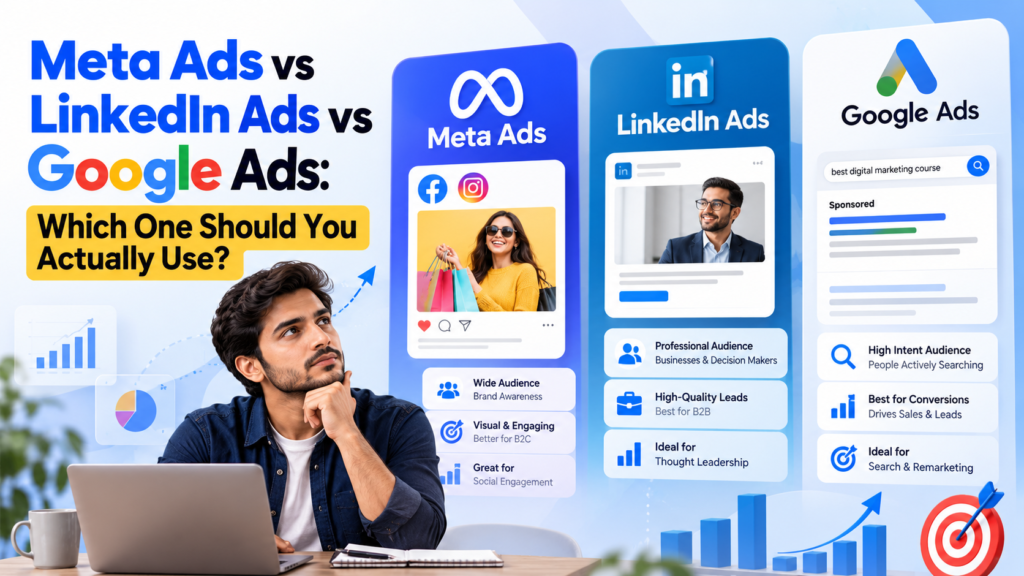
Google captures demand that already exists. Meta creates interest. LinkedIn lets you choose your audience by their professional profile. Everything else follows from this.
When Google Ads is the right choice
Choose Google when people already search for what you sell. That covers a lot of businesses: plumbers, dentists, coaching institutes, accounting software, wedding photographers, B2B services with a clear search term attached.
Search ads work best when:
- The need is urgent or specific (“emergency AC repair,” “GST registration consultant”)
- Your product has a clear name that people type into a search box
- You want leads who are close to buying, not just curious
- Your offer is easy to explain in a headline and a couple of lines
The main drawback is that people with strong intent are also targeted by all your competitors, so clicks in competitive categories can get expensive. And if nobody searches for what you sell (a new product category, say), Google has little to work with. You cannot capture demand that is not there yet.
Google also offers more than search. YouTube, Display and Performance Max reach people beyond search results, but beginners should start with Search campaigns. They are the easiest to understand and the easiest to judge.
When Meta Ads makes more sense
Meta is strong when the product is visual, emotional, impulsive or local, or when people would not think to search for it until they see it.
Think of a boutique launching a new festive collection, a café with a new menu, a fitness studio offering a free trial week, or a home baker. Nobody wakes up searching for “that specific brownie I haven’t tasted yet.” But show them a great photo and a good offer, and plenty of people will click.
Meta tends to work well for:
- E-commerce and D2C brands, especially anything that looks good in an image or a short video
- Local businesses targeting a city or a few kilometres around a location
- Events, webinars and workshops, where you need registrations
- Remarketing, meaning showing ads to people who already visited your website or engaged with your page
- Lower-priced products, where the decision takes minutes, not weeks
Meta’s weakness is intent. A person who clicks a Meta ad was often interested for a second, not ready to buy. Lead quality can swing widely, particularly with instant lead forms, which are easy to fill but also easy to fill carelessly. If you run Meta lead campaigns, plan on calling people quickly and qualifying them, or add a question or two that filters out the casual clicks.
When LinkedIn Ads is worth the higher price
LinkedIn is the platform where you can say “I want to reach Heads of HR at companies with 200 to 1,000 employees” and actually do it. No other platform makes that as easy.
It earns its higher cost in these situations:
- You sell B2B to a specific job role or industry
- A single customer is worth a lot, such as software subscriptions, consulting contracts, recruitment services or enterprise training
- You are promoting senior-level content, like a whitepaper, a report or a leadership event
- You do account-based marketing and want to reach specific companies
Be honest about the math before you start. Clicks on LinkedIn typically cost noticeably more than on the other two platforms. If your average sale is ₹2,000, it is hard to make that work. If one client is worth ₹5 lakh a year, paying more per lead is perfectly reasonable.
A common mistake is using LinkedIn for a broad consumer offer. You pay a premium for professional targeting you are not even using.
A quick way to decide
Ask yourself these questions in order:
- Do people search for this? If yes, start with Google.
- Is this a visual, low-to-mid-priced or local offer? Meta is probably your best first test.
- Do you sell to a specific job role or company type, and is each customer worth a lot? Then LinkedIn deserves a seat.
Two quick scenarios show how this plays out. A CA firm offering startup compliance would likely begin with Google Search for people looking for those services, and maybe use LinkedIn later to reach founders by title. A new bakery in a residential neighbourhood would do better on Meta, with photos of the product and a tight location radius. These are illustrations, not rules, but the logic carries over to most businesses.
Mistakes that burn budget
Running all three at once with a small budget. Each platform needs enough spend to produce useful data. Three thin campaigns teach you nothing. One properly funded campaign teaches you plenty.
Judging platforms by the wrong metric. Meta often looks cheaper on cost per click, and Google or LinkedIn often look better on lead quality. Compare cost per qualified lead or cost per sale, not clicks.
Sending traffic to a weak landing page. The best targeting on any platform cannot fix a page that is slow, confusing or unclear about what to do next.
Ignoring follow-up. A lead that waits two days for a call is mostly a wasted lead, whichever platform sent it.
Not tracking conversions. Without proper tracking in place, you are guessing. Set up conversion tracking before you spend heavily, not after.
Do they work better together?
Often, yes, but in the right order. Many businesses start with one platform, find a profitable pattern, and then add a second to cover a gap. A typical path: start with Google Search to capture ready buyers, add Meta remarketing to bring back visitors who did not convert, and bring in LinkedIn only if the economics support it.
The platforms also support each other. Someone may see your Meta ad, search for your brand on Google later, and convert there. That is why channels can look weaker in reports than they really are, so it helps to look at the whole picture and not only the last click.