Bad Prompt vs Good Prompt: What It Really Means for Your Digital Marketing
A marketer types “write a Facebook ad for my gym” into an AI tool. Out comes a cheerful, generic paragraph about “achieving your fitness goals” that could belong to any gym in any city. They sigh, decide the tool isn’t very good, and go back to writing the ad by hand.
The tool probably wasn’t the problem. The prompt was. The difference between a bad prompt and a good one decides whether AI saves you hours or just hands you more editing, and it shows up in ad copy, SEO content, emails and reporting.
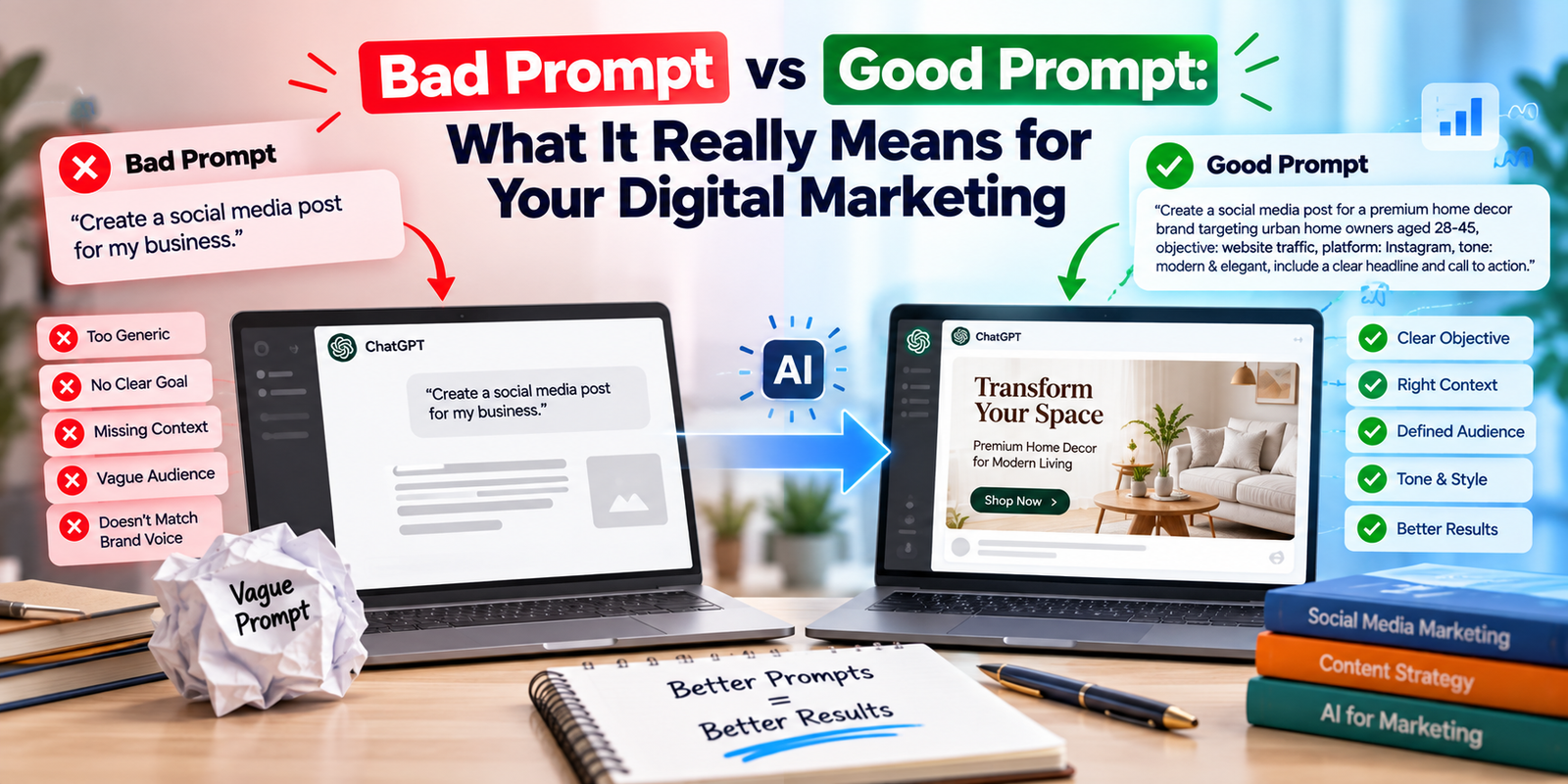
What makes a prompt “bad”?
A bad prompt isn’t rude or wrong. It’s just thin. It leaves the AI to guess who you are, who you’re talking to, and what you want, so it falls back on the most average answer it can produce.
Most weak prompts share a few traits:
- No context. The AI doesn’t know your business, your product or your location.
- No audience. “Write a post” for whom? College students and retired professionals need very different words.
- No goal. Is the copy meant to get clicks, sign-ups, replies, or just awareness?
- No limits. No word count, tone, format or things to avoid.
Think of briefing a new freelancer by saying “make me an ad.” You’d get something back, and you’d be disappointed. The same logic applies to AI.
Bad prompt vs good prompt: side-by-side examples
Here are four common marketing tasks. The businesses below are made up for illustration.
Example 1: Ad copy
Bad prompt:
Write a Facebook ad for my gym.
Good prompt:
Write three Facebook ad variations for a small neighbourhood gym in Pune targeting working professionals aged 25 to 40 who keep skipping workouts because of long office hours. The offer is a free 7-day trial. Tone: friendly and direct, no hype. Keep each ad under 50 words and end with a clear call to action to book a slot.
The first gets you a generic ad. The second gets you something you can actually test, written for a specific person with a specific problem.
Example 2: Blog content
Bad prompt:
Write a blog post about skin care.
Good prompt:
I run a small online store selling fragrance-free skincare for sensitive skin. Suggest 10 blog topics for people who react badly to most products, with a search-friendly working title for each and a one-line note on what the post should cover. Avoid generic topics like “10 skincare tips.”
Notice that the good version asks for ideas first, not a finished post. That’s often smarter. You review the direction before spending time on a draft.
Example 3: Email subject lines
Bad prompt:
Give me email subject lines for my sale.
Good prompt:
Write 8 email subject lines for a weekend sale on handmade leather wallets. The audience is existing customers who have bought from us before. Keep each under 50 characters, avoid all caps and spammy words like “free” or “urgent,” and mix curiosity-based and benefit-based styles.
Example 4: Keyword and content research
Bad prompt:
Give me SEO keywords for my course.
Good prompt:
I run a digital marketing training institute and want to attract working professionals and graduates in Thane who are comparing course options. Suggest keyword themes grouped by search intent (research, comparison, ready-to-enrol). I will validate volumes in a keyword tool myself, so focus on ideas, not numbers.
That last sentence matters. Telling the AI what you’ll verify yourself keeps it from inventing figures.
Why this matters for digital marketing results
Better prompts won’t make a weak product sell. But in day-to-day marketing work, the gap between the two kinds of prompt adds up in a few clear ways.
Time. A vague prompt usually means five rounds of “make it shorter,” “make it less formal,” “no, not like that.” A detailed prompt gets you closer on the first try. You spend a few extra minutes up front and save much more on revisions.
Brand consistency. Without direction, the AI defaults to a bland, slightly over-excited voice. If your brand is calm, witty or technical, you have to say so. Teams that save a short “brand voice” paragraph and paste it into every prompt tend to get far more consistent output.
Ad testing. Good prompts make it easy to produce meaningfully different variations: one built around price, one around convenience, one around a pain point. Bad prompts produce five versions of the same sentence, which gives you nothing to test.
SEO content quality. Search engines and readers both reward content that is specific and useful. A vague prompt creates vague articles that sound like everything else already ranking. Giving the AI your actual angle, audience and real details from your business is what pushes the output beyond filler.
Risk. Weak prompts also invite mistakes: made-up statistics, exaggerated claims, offers you don’t actually run. The more specific you are about what to include and what to avoid, the less cleanup you do before publishing.
A simple structure for writing better prompts
You don’t need a fancy formula. Most strong marketing prompts answer these questions:
- Who is the AI acting as? (“You are a content strategist for a B2B software company.”)
- What’s the business and offer? Give real details.
- Who is the audience? Age, role, problem, level of awareness.
- What’s the task? Be specific about what you want produced.
- What are the constraints? Length, tone, format, words to avoid.
- What does good look like? Paste a sample of your past work if you have one.
You won’t need all six every time. A quick task might need only three. But if the output feels off, the missing piece is usually one of these.
Mistakes that still trip people up
Asking for everything at once. “Write a full content calendar, ten blogs, and social posts for the year” produces a shallow mess. Break big jobs into steps.
Never giving feedback. The first response is a draft. Tell the AI what to change: “The second option is closest, but make it less formal and cut the first sentence.” Conversation beats starting over.
Trusting facts blindly. AI tools can state wrong things confidently. Check any statistic, platform rule, price or claim before it goes live.
Skipping your own knowledge. The AI can’t know that your customers hate the word “cheap,” or that your best-selling product is the unglamorous one. You can. Adding those details is where your expertise shows up.
Publishing without editing. Even a great prompt gives you a first draft. Your edit, your examples and your judgment are what make the final piece sound like a person wrote it.
Conclusion
The tools are the same for everyone. What separates average output from useful output is the quality of the brief you give them. A bad prompt asks the AI to guess, and a good prompt gives it enough to do real work.
Next time the result looks flat, don’t switch tools right away. Reread your prompt and ask whether a human freelancer could have done a good job with those same instructions. If the answer is no, add the missing context and try again.